
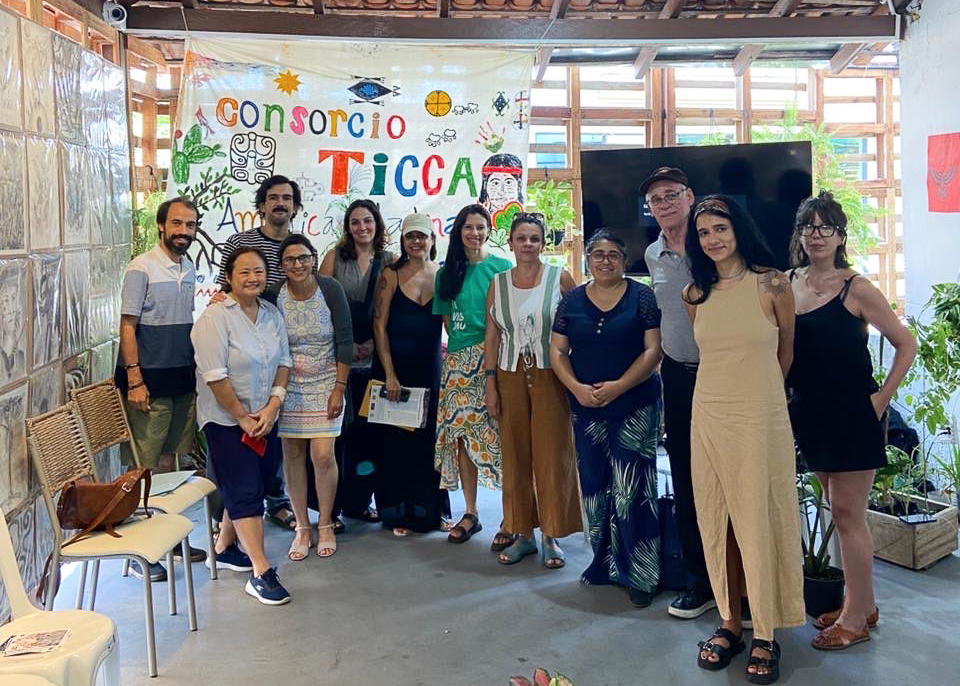
When COP do Povo – the People’s COP – unfolded across Belém, Brazil, in November 2025, something shifted. The city became more than the backdrop for an international climate summit. It became a living arena for people-led climate action, ancestral resistance, and collective protection.
COP30 also marked a turning point for Open Briefing. For the first time, our team was on the ground supporting activists, Indigenous leaders, and grassroots partners to stay safe, resilient, and able to participate fully in a grassroots, community-led alternative space, COP do Povo.
Belém hosted the highest level of public participation in COP history. Around 70 people-led spaces emerged across cultural centres, community territories, and universities, reclaiming the city for those on the frontlines: Indigenous nations, Quilombolas*, riverside communities, youth movements, and international allies. Their presence underscored a crucial truth: rural, forest, and traditional communities are the main defenders of climate justice and stability.
While formal negotiations often felt distant, spaces such as Aldeia COP, COP do Povo, Cúpula dos Povos, and COP das Baixadas were grounded in lived experience. More than 3,000 Indigenous representatives gathered under the guiding idea that “the answer is us,” and their mobilisation contributed to a major milestone – the official recognition of ten Indigenous territories during COP30.
Invited by Instituto Zé Cláudio e Maria and Brazilian civil society partners, Open Briefing provided holistic security and safeguarding support at Casa COP do Povo. As our associate director of safety and security, Renata Oliveira, said, our presence was about “listening, learning, and co-creating security strategies that reflect the realities [people face] on the ground.” We also supported the People’s Tribunal against Ecogenocide, helping organisers manage risks as communities denounced persecution, attacks, and the killings of defenders.
Our work in Belém built on months of preparation. This included the COP30 Guide produced with CliDef and Arayara, as well as support provided to defenders through our fully funded responsive assistance mechanism, which extended to those facing risk before, during, and after COP.
Across all spaces, care was constant. As our safety and security coordinator, Carla Vitória, reflected, “Activists checked in on one another, shared risk information, and supported those facing harm – a reminder that holistic security is not a theory, but a collective necessity.”
With the support of our incredible community of funders, we are proud to have strengthened and expanded our work with Indigenous, land, and environmental defenders across the globe over the past year. People-led spaces like COP do Povo show that climate justice emerges from those living closest to the land – and that their safety and wellbeing must be integral to climate action. Belém made this clearer than ever.
*Quilombolas are members of Afro-Brazilian communities that trace their ancestry to escaped enslaved Africans who, during colonial times in Brazil, fled plantations and formed independent settlements known as quilombos.
Access further support and get involved
Open Briefing provides fully-funded assistance to activists and organisations facing threats related to their work. You can request support through our responsive assistance mechanism.
If you’re a foundation or philanthropist who believes in protecting the people who defend human rights, we’d love to hear from you. Contact our director of development, Vicky Nida at [email protected] to discuss how you can join our incredible community of donors or read more about how Open Briefing works with foundations to strengthen civil society in our latest blog.