
The way we think about protection has always evolved alongside the challenges facing the people and movements we seek to support.
Today, human rights defenders, journalists, environmental activists, and civil society organisations are navigating an increasingly complex landscape. Physical threats remain a dangerous reality, but they are now often accompanied by digital surveillance, shrinking civic space, climate shocks, and the cumulative effects of burnout and trauma. These pressures rarely occur in isolation or end when a single incident has passed.
As we began marking Open Briefing’s 15th anniversary, we wanted to use the opportunity not simply to reflect on the past, but to bring together partners and practitioners to explore how our understanding of protection is changing, and what that means for people and movements leading change under pressure.
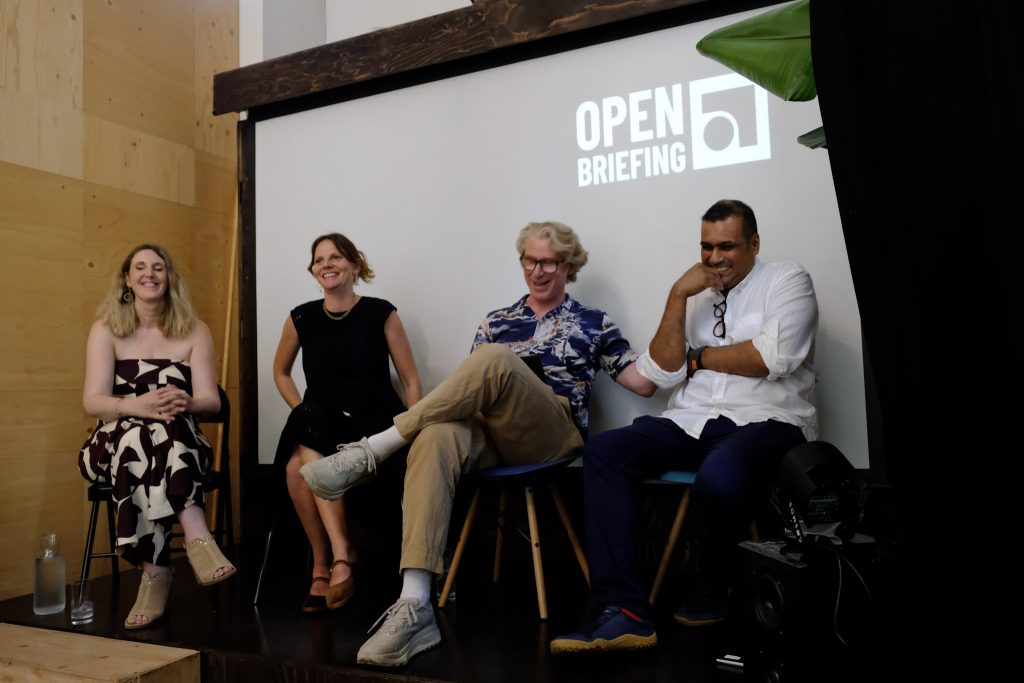
During London Climate Action Week, we were delighted to welcome supporters, partners, and friends to the premiere of our new film. The screening was followed by a panel discussion featuring Millie Edwards, director of The Iris Project; Gus Hosein, executive director of Privacy International; and Camille Gallié, Open Briefing’s director of wellbeing and collective care. The discussion was chaired by Jim Peacock, a member of Open Briefing’s development board.
The conversation reflected many of the ideas explored in our recently launched 2026–2029 impact strategy, Regenerative protection for action under pressure. It also highlighted a broader shift taking place across civil society: a growing recognition that meaningful protection is about more than responding to immediate threats. It is about creating the conditions for people and movements to continue their work over the long term.
Beyond responding to immediate threats
Introducing Open Briefing’s new strategy, our founder and CEO, Chris Abbott, described regenerative protection as going beyond responding to immediate threats and instead seeking to “renew the human infrastructure of social and environmental change”, recognising that, “systems don’t change systems… people change them.”
That perspective set the tone for much of the evening’s discussion.
As Jim reflected, civil society increasingly faces overlapping pressures – including authoritarian repression, environmental destruction, and digital surveillance – that are not temporary disruptions but sustained realities. For many organisations and movements, the challenge is no longer simply responding to moments of crisis. It is finding ways to continue working safely and effectively while living with permanent uncertainty and pressure.
That shift changes how we think about protection. Alongside reducing immediate risks, there is a growing recognition of the need to restore agency and confidence, strengthen relationships, and build the conditions that allow action to continue over time.
Starting with people’s realities
Another theme that surfaced repeatedly was the importance of context.
Millie described how the risks facing many of the young environmental leaders she works alongside at the Iris Project continue to evolve. Environmental crises remain ever-present, but they are increasingly intertwined with digital surveillance, political pressure, and the emotional demands of long-term organising. As she reflected, “mental health and burnout is constant.”
Her experiences reinforced another important point: meaningful protection cannot be one-size-fits-all. The support needed by a young organiser responding to climate disasters in the Philippines will look very different from that required by an environmental campaigner navigating digital surveillance in Mongolia. Effective protection begins by understanding people’s contexts, listening to their priorities, and responding to the realities they face.
From individual resilience to collective care
One of the strongest themes to emerge from the panel was the growing recognition that approaches to strengthening individual and collective wellbeing cannot be separated from effective protection support.
Reflecting on her experience supporting defenders and organisations at Open Briefing, Camille noted that “before it was almost seen as a good way to be an activist – to burn out.” Increasingly, however, organisations and movements are questioning that assumption. Burnout is no longer viewed as an inevitable consequence of working for social change, but as something that can and should be addressed collectively.
Camille suggested this means looking beyond the absence of harm. As she put it, “It’s not only enough to say, ‘You don’t have a disease’… You want to be healthy.”
Organisations are asking different questions. How do we build healthier organisational cultures? How do we strengthen peer support? How do we create practical systems that help people continue doing difficult work without carrying the burden alone?
This shift is also prompting organisations to look more critically at their own protection practices. Rather than treating protection as a standalone service or simply a response to crisis, organisations are increasingly embedding it into the way they work, the way they support one another, and the conditions they create over time.
Reflecting on Privacy International’s experience, Gus recalled initially questioning whether an external review of the organisation’s digital security practices was really necessary. Looking back, he described the experience as transformative: “We thought we were good, and then we realised this is how far we’d fallen short.” The process expanded and helped embed conversations about risk, wellbeing, and organisational culture into everyday practice. Gus reflected it was a reminder that protection is not something organisations achieve once and for all, but something they continually strengthen, adding “We would not exist today were it not for Open Briefing.”
Shared responsibility for protection
That shift has important implications for duty of care. Rather than being understood primarily as a legal obligation or a set of minimum standards, Camille reflected that organisations are coming to recognise it as “a holistic approach where protection in its fullest is really embedded throughout the duty of care”, woven into leadership, organisational culture, systems, and everyday practice.
The discussion also explored what this means for foundations and other organisations supporting civil society. As locally led approaches become more widely adopted, Camille emphasised that they “also require investment” and a “proper assessment of how they will safely transfer the risk locally and how they will potentially burden the communities and the movements they are trying to support.”
She cautioned that there is a limit to what can reasonably be expected of grassroots organisations and movements. Defenders are now increasingly expected to expertly navigate physical security, digital security, wellbeing, legal rights, and financial strain, often while working under increasing pressure from the state and other adversaries. “That’s too much,” she reflected, arguing that “they really need allies.”
Millie echoed this from a funder’s perspective: “As funders, we need to be doing more.” She challenged the assumption that already overstretched organisations should be expected to absorb the additional costs of protection and wellbeing, arguing that strengthening organisational capacity and care should be recognised as an essential part of sustaining civil society over the long term.
Building on these reflections, Jim highlighted the importance of ensuring that “we’re not putting the onus of responsibility onto the very people who are under most threat.” Instead, the discussion pointed towards a more shared understanding of protection – one in which civil society organisations, funders, and protection practitioners all have a role to play in creating the conditions that enable people and movements to continue their work safely and sustainably.
Looking ahead
One message came through particularly clearly. Reducing harm is essential. But it is not enough. It must help defenders and movements stay connected to their communities, recover agency, strengthen confidence, and build the conditions to keep going.
These ideas are explored further in our impact strategy, Regenerative protection for action under pressure, which sets out how we believe protection can help restore agency, strengthen relationships, and renew action under pressure.
As Chris reflected towards the close of the evening, “Regenerative protection is about restoring agency and confidence in ways that ripple outwards from individual defenders to their families, their communities, their organisations, and their movements.”
He ended with a reminder of why those conversations matter:
“After 15 years of Open Briefing, I believe more than ever in a world where hope can become change. Change is possible. And that’s why we keep doing what we do.”
Explore further
Read our impact strategy, Regenerative protection for action under pressure, to learn more about the thinking behind our evolving approach and the priorities that will guide our work over the coming years.
Watch our new film, which brings together reflections from partners and team members on what protection means in practice and why renewing people and movements matters.
Subscribe to our newsletter, The Briefing, for future articles, practical resources and updates from our work alongside people and movements leading change under pressure.