
Green Development Advocates (GDA) is a Cameroonian civil society organisation working alongside Indigenous peoples and local communities whose territories and forests are affected by extractive and large-scale agro-industrial projects, including mining and palm oil production.
GDA works to ensure that the rights and interests of those communities are represented in decisions affecting their territories. Combining legal expertise and advocacy with direct support, the organisation helps communities secure and manage community forests as an alternative to larger-scale developments that can threaten local livelihoods and biodiversity.
Working in this context can bring risks for both communities and those accompanying them. GDA has experienced security incidents, particularly during its field work with communities, alongside potential threats to its reputation, legitimacy, and financial security.
As Mélanie Paboeuf, protection and security consultant at Open Briefing, explains, the threats GDA faces reflect wider patterns experienced by human rights defenders:
“Defamation against those who defend rights or restricting access to funds are unfortunately all-too-common strategies used by political and economic actors to deter or prevent human rights defenders from carrying out their work. Detecting these patterns often does not eliminate the threats at their source. But it does help defenders better prepare for them and put in place measures that reduce both the likelihood and impact of these threats affecting them and their work.”
In 2025, GDA connected with Open Briefing through The Coalition for Human Rights in Development – one of GDA’s funders and a referral partner of Open Briefing. The team wanted to formalise and strengthen its approach to security.
This began an ongoing process of bringing together GDA’s knowledge of its own context and communities with Open Briefing’s protection expertise.
Building a holistic approach to protection
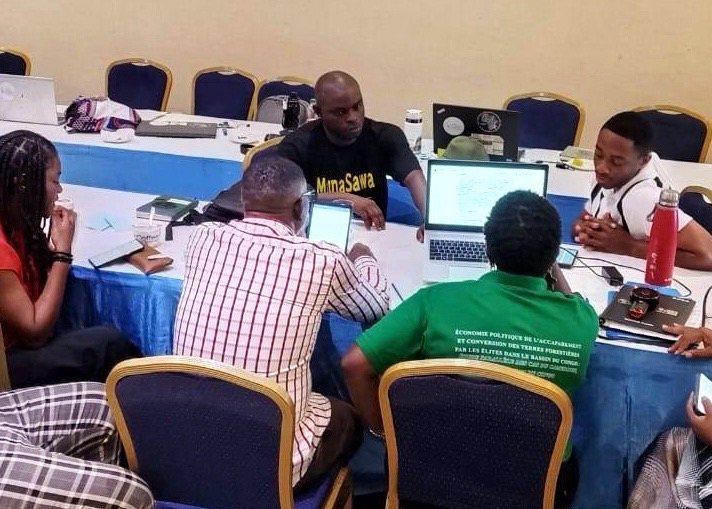
During an initial two-day workshop in Douala in November 2025, Open Briefing and GDA worked together to analyse the risks the organisation faced and identify preventive security measures for its headquarters and field activities.
The workshop took a holistic approach to security, looking not only at physical safety but also at collective care and organisational capacity, emergency response, and the role that advocacy and communications can play in protection.
Mélanie shares that developing a security plan is only the beginning:
“Holistic security is a process. The issues discussed and the protection measures and strategies agreed during a first workshop need to be deepened and adapted over time, according to how the context and risk evolve and the organisation’s actual capacities.”
In September 2026, Mélanie returned to Cameroon for a second two-day workshop with GDA. The follow-up created an opportunity to revisit the risks facing the organisation, look at how the original security plan was being used, bring newer team members into the process, and agree collectively what needed to happen next.
Putting the plan into practice
The review showed that progress had not been linear. Some measures agreed during the first workshop had fallen out of use, and newer team members now needed to be brought into the process.
At the same time, GDA described a broader change in how protection featured in its work. Véronique Mbole, a gender and advocacy officer at GDA, shared:
“We have gone from just thinking about safety and security to seeing beyond that – understanding that there are latent threats, that there are vulnerabilities, and that there are different ways in which we can respond to threats.”
That shift can be seen in some practical changes adopted by the team. GDA staff now incorporate risk analysis into terms of reference for field activities, record security incidents experienced in the field in activity reports, and consider possible scenarios and threats when planning annual activities.
The group also explored digital security in more depth, including setting up two-step verification and considering the use of tools such as Signal for internal communications.
Working alongside communities
The second workshop also created space to look more closely at the relationship between GDA’s own security and that of the communities it works alongside.
Together, the group explored how GDA can respond when communities experience security incidents: where it has the appropriate capacity to act directly, when allies can be brought in, and when another organisation may be better placed to respond. They also considered how to establish effective communication channels with communities and how GDA can manage the risks that its own visits and accompaniment may create.
The workshop concluded with a practical exercise based on a fictional case involving the criminalisation of a community supported by GDA. Rather than approaching criminalisation solely as a legal issue, the group considered how different elements of holistic security could work together – including legal support, strategic communications, advocacy, alliances, physical and digital security, and attention to psychosocial impacts.
This also meant considering GDA’s own limits and how to avoid risk being transferred from a community to its team.
The second workshop strengthened the approaches, systems and relationships GDA can draw on as it accompanies communities facing risk. Over time, the aim is for this work to increasingly inform GDA’s day-to-day collaboration with communities and contribute to their longer-term safety and protection.
Creating additional space for informal conversations
The follow-up meeting also created additional space for informal conversations and collective reflection alongside the planned exercises. This enabled relationships and trust within the GDA team to deepen and gave Mélanie a better understanding of how the team discussed risks, reached decisions, and worked together.
These conversations also surfaced other priorities. GDA expressed an interest in learning more about international standards for protecting human rights defenders, for example, and Mélanie is in the process of connecting the team with international law experts in her network.
Continuing the process
Mélanie is in the process of developing updated protocols that draw on learning from both workshops, with additional guidance on working alongside communities and in the field. GDA will discuss the draft collectively before coming back together with Open Briefing to refine the ways of working, incorporating the team’s feedback and priorities.
This approach reflects an idea at the heart of Open Briefing’s 2026–29 strategy: “Protection is not something done to defenders. It is created with them. Those closest to risks hold the deepest knowledge of their context. Our role is to contribute our expertise into processes while keeping power, decision-making and ownership with the people and organisations we work alongside.”
For Marius Gautier Mongo, a community tenure lawyer at GDA, the next step is to carry this forward:
“It is now up to us to build on everything we have learned and use it in our day-to-day support to communities – helping them, for example, to better structure their assessments and better plan programmes, events or actions.”